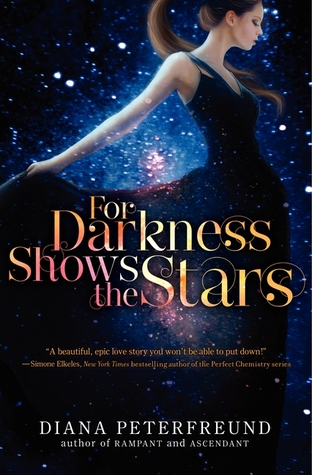
In
this sci-fi adaptation of Jane Austen's Persuasion, the human race is
still reeling from scientific experiments gone wrong and is now being
led by the Luddite nobility. Years before the events of this novel, some
ambitious scientists found a way to manipulate DNA to make better
humans. However, when the offspring of these people were all born with
severe mental retardation, called the Reduction, it appeared to be the
end of the human race until the Luddites, a strict religious minority
who had been in hiding, came out and became the new majority. Elliot,
our protagonist, has been managing her Luddite family's estate since the
death of her mother four years prior, while her father and sister spend
the family's money with no qualms about their impending poverty. When
Elliot is approached by a post-reductionist fleet, the mentally capable
children of the reduced, about renting property from her to build a
boat, she grabs at the opportunity to make a little more money to help
her family and those living on their property survive, not knowing that
part of this fleet is Captain Malakai Wentforth, the boy who she refused
to run away with after her mother's death.
This book was
absolutely incredible. Whether you're a Jane Austen fan, a sci-fi fan,
or neither, you should read this book anyway because it was so amazing
(but if you are either or both of those you'll find it all the more
entertaining). The science fiction part of the novel was relatively tame
but still strong enough to keep the part of me that longs for the
extraordinary happy.
Not only was the story and how Jane Austen's
tale of long-lost love was adapted fascinating, but the way the story
was written and told was exceptional as well. I thought the pace was
perfect. Persuasion is not a particularly climactic tale, but
Peterfreund managed to space out little tidbits of information to shock
the reader just enough so that you absolutely have to continue reading.
What I loved most though were the personalities of the characters.
Almost every one was round, the heroes, villains, and un-labelable, and
acted as a real person would. All in all, this was a phenomenal book and
if you haven't read it yet, you're missing out.
5 stars.
 It's been several
generations since a genetic experiment gone wrong caused the Reduction,
decimating humanity and giving rise to a Luddite nobility who outlawed
most technology.
It's been several
generations since a genetic experiment gone wrong caused the Reduction,
decimating humanity and giving rise to a Luddite nobility who outlawed
most technology.
Elliot North has always known her place in this
world. Four years ago Elliot refused to run away with her childhood
sweetheart, the servant Kai, choosing duty to her family's estate over
love. Since then the world has changed: a new class of
Post-Reductionists is jumpstarting the wheel of progress, and Elliot's
estate is foundering, forcing her to rent land to the mysterious Cloud
Fleet, a group of shipbuilders that includes renowned explorer Captain
Malakai Wentforth--an almost unrecognizable Kai. And while Elliot
wonders if this could be their second chance, Kai seems determined to
show Elliot exactly what she gave up when she let him go.
But
Elliot soon discovers her old friend carries a secret--one that could
change their society . . . or bring it to its knees. And again, she's
faced with a choice: cling to what she's been raised to believe, or cast
her lot with the only boy she's ever loved, even if she's lost him
forever.
Inspired by Jane Austen's Persuasion, For Darkness Shows the Stars is a breathtaking romance about opening your mind to the future and your heart to the one person you know can break it.
Almost
as far back as she can remember, Rachel has been locked in a tower for
her protection. Her Mama tells her that she must stay hidden from the
bad man who killed her mother and wants to kill her as well. However,
lately Rachel has been having dreams of a mysterious man and as her hair
grows longer, Rachel sings out her window and longs for someone to hear
her and release her from her prison. Wyatt has been shipped to a tiny
town in upstate New York for the rest of the school year and is living
with a little old lady whose daughter used to be his mom's best friend.
As he settles in, Wyatt starts hearing a haunting voice singing that no
one else can hear, and when he investigates he finds a beautiful girl
who has been locked in a tower for almost her entire life. The two of
them team up and hope to free Rachel from her tower once and for all.
I
absolutely love Alex Flinn's other fairy tale retellings. Beastly and A
Kiss in Time are two of my favorite books ever, and I was very excited
to read Towering. However, Towering had a very different feel to it than
the others. Perhaps it was the the plot involving drug lords rather
than princesses, but the overall tone of this novel was a lot darker
than the others. This is only a negative point because I expected a
colorful adventure like the ones in all the other books, but instead
found this one a dull gray. The story was also told a bit too slowly,
and I had to push myself to get through at least half the book before I
actually wanted to open it up and devour it.
***SPOILERS AHEAD***
One
problem I always had with the story of Rapunzel, especially the Disney
version, is the Rapunzel has no problem killing the woman who raised
her. Yes, she was evil and kept her locked up for all those years, but
she never did her any physical harm and Rapunzel was taken away young
enough to not remember anything better. Therefore, without taking into
account the moral compass of the witch, Rapunzel killing the witch is
not an act of a hero conquering a villain, but of someone turning her
back on the woman who rose her. Rapunzel killing the witch may have
turned out okay because the witch was evil, but imagining Rapunzel as
pure and good is projecting the third-person perspective of the story
onto Rapunzel, who doesn't know that the witch is evil until she falls
for a stranger who climbs through her window and he tells her so. This
monologue brings me to my point, which is that finally the captor is not
the evil one. It was a relief to have the villain be someone else
entirely with Mama being entirely innocent, and it let Rachel be a true
heroine.
3.6 stars
At first, I merely
saw his face, his hands on the window ledge. Then, his whole body as he
swung himself through the window. Only I could not see what he swung on.
Until,
one day, I told my dream self to look down. And it was then that I saw.
He had climbed on a rope. I knew without asking that the rope had been
one of my own tying.
Rachel is trapped in a tower, held
hostage by a woman she’s always called Mama. Her golden hair is growing
rapidly, and to pass the time, she watches the snow fall and sings songs
from her childhood, hoping someone, anyone, will hear her.
Wyatt
needs time to reflect or, better yet, forget about what happened to his
best friend, Tyler. That’s why he’s been shipped off to the Adirondacks
in the dead of winter to live with the oldest lady in town. Either
that, or no one he knows ever wants to see him again.
Dani
disappeared seventeen years ago without a trace, but she left behind a
journal that’s never been read, not even by her overbearing mother…until
now.
In
the final book about the Twelve Dancing Princesses, the main character
is the youngest sister, Petunia. Petunia is on her way to visit an old
duchess from Russaka (Russia's equivalent in the alternate universe)
when her carriage is overtaken by the Wolves of the Westfalin Woods (or
something alliterative like that). When Petunia turns out not to be as
docile as expected, Oliver, the leader of the wolves, unintentionally
kidnaps her. Feeling bad for what he's done, Oliver brings Petunia to
her destination, and while there, he discovers that Petunia is in
danger. The new King Under Stone is determined to have his twelve
brides, and will do anything to get them in his clutches once and for
all. Will the sisters' fight against the evil king finally end, almost
fifteen years after it started?
The first book in this series,
Princess of the Midnight Ball, was about Rose, the oldest of the 12
sisters. The second book, Princess of Glass, was about Poppy, one of the
many middle sisters. This is the last book, and it is about Petunia,
the youngest of them all. I liked how there was time between the 1st and
2nd, and 2nd and 3rd of the novels because it shows more development in
the characters. The 2nd book didn't take place in the Westfalin castle
so there was barely any interaction between the sisters, but I liked how
in the 3rd book I could compare the sisters as they are now to how they
were almost ten years earlier in the 1st book. It was also fun to see a
continuation of all the little nuances in each of the sister's
characters. Each one had a distinct character trait in the first book
(there are too many sisters for each one to have a fully developed
character) and they still had in this book, just all grown up. I just
realized that what I wrote is a long chain of babbling. I hope it makes
sense.
This book got a lot darker than I expected it too, but
the ending was adorable. The dark and twisty parts didn't stray too much
from the overall cuteness, but it did give the story more validity.
One
last thing before I go: I realized while reading this book that the
only other books with the names Pansy and Petunia in them are the Harry
Potter books. And they weren't exactly pleasant characters there either.
Just something to think about :)
4.6 stars.
Before reading the publisher's summary, I want to warn any prospective readers that it contains some information that may be classified as spoilers. (I consider any information not discovered until halfway or through or not blatantly obvious to be a spoiler.)
 When Petunia, the
youngest of King Gregor's twelve dancing daughters, is invited to visit
an elderly friend in the neighboring country of Westfalin, she welcomes
the change of scenery. But in order to reach Westfalin, Petunia must
pass through a forest where strange two-legged wolves are rumored to
exist. Wolves intent on redistributing the wealth of the noble citizens
who have entered their territory. But the bandit-wolves prove more
rakishly handsome than truly dangerous, and it's not until Petunia
reaches her destination that she realizes the kindly grandmother she has
been summoned to visit is really an enemy bent on restoring an age-old
curse.
The stories of Red Riding Hood and Robin Hood get a twist as
Petunia and her many sisters take on bandits, grannies, and the new King
Under Stone to end their family curse once and for all.
When Petunia, the
youngest of King Gregor's twelve dancing daughters, is invited to visit
an elderly friend in the neighboring country of Westfalin, she welcomes
the change of scenery. But in order to reach Westfalin, Petunia must
pass through a forest where strange two-legged wolves are rumored to
exist. Wolves intent on redistributing the wealth of the noble citizens
who have entered their territory. But the bandit-wolves prove more
rakishly handsome than truly dangerous, and it's not until Petunia
reaches her destination that she realizes the kindly grandmother she has
been summoned to visit is really an enemy bent on restoring an age-old
curse.
The stories of Red Riding Hood and Robin Hood get a twist as
Petunia and her many sisters take on bandits, grannies, and the new King
Under Stone to end their family curse once and for all.
Alice
is in trouble. Her mother, a romance author crowned the Queen of
Romance, is in a psychiatric facility getting treatment for bipolar
disorder, and if she doesn't write another book in the next few weeks
then they are going to be utterly and completely broke. The only
solution Alice can think of is to write the book herself under her
mother's name-but what should she write about? Enter Eros, the crazy guy
who thinks he's Cupid. Eros keeps bothering Alice and begging her to
write his story, about his tragic love with Psyche. Alice has only a few
weeks to put together her novel while taking care of her mother and
trying not to alienate the cute guy who she's been crushing on for
months who she finally met. Can she do it?
This book is a lot
more serious than I expected, which is why I included more in my summary
than the publishers did in theirs. From the summary I expected a
happy-go-lucky love story about a girl biting off more than she can
chew, but instead this book was rife with sicknesses of the body and the
mind, serious financial problems, and personal blackmail. It was sort
of like taking a bite of what you think is cotton candy and getting a
bite of chicken instead. You still enjoy the chicken, but you're
confused as to what happened to the cotton candy. (I just realized how
stupid that sounds, but if you read the book you'd understand what I was
talking about.) This also prepared me for the cheesiness of the romance
because even though the book was a lot grittier than I thought it would
be, Alice and Tony's romance was just as bubbly and superficial as I
had predicted. However, this didn't annoy me nearly as much as it
usually would, just because I knew it would be like that.
I
thought it was really cool to read about bipolar disorder because I had
just learned about it in my abnormal psychology class before reading the
book. When Alice described her mother's symptoms and actions I was able
to reference my notes in my head and see how they matched up, which
they did perfectly.
The main reason why I would recommend this
book to anyone is because of how original it is. There are many takes on
the Cupid and Psyche romance, but this one was different than the
others because the main character was not Cupid or Psyche but someone
else totally.
4.7 stars
 When you're the
daughter of the bestselling Queen of Romance, life should be pretty
good. But 16-year-old Alice Amorous has been living a lie ever since her
mother was secretly hospitalized for mental illness. After putting on a
brave front for months, time is running out. The next book is overdue,
and the Queen can't write it. Alice needs a story for her mother-and she
needs one fast.
When you're the
daughter of the bestselling Queen of Romance, life should be pretty
good. But 16-year-old Alice Amorous has been living a lie ever since her
mother was secretly hospitalized for mental illness. After putting on a
brave front for months, time is running out. The next book is overdue,
and the Queen can't write it. Alice needs a story for her mother-and she
needs one fast.
That's when she meets Errol, a strange boy who
claims to be Cupid, who insists that Alice write about the greatest love
story in history: his tragic relationship with Psyche. As Alice begins
to hear Errol's voice in her head and see things she can't explain, she
must face the truth-that she's either inherited her mother's madness, or
Errol is for real.
After
her father loses all of their money in a Ponzi-like scheme and dies
shortly after, Rose is left completely destitute with nowhere to go. So
when Jason Cameron, a railroad baron and secret sorcerer, offers her a
position as a governess, she has no choice but to accept. Upon arrival
in his manor, she discovers that her students are not two precocious
children, as she was first informed, but her new boss himself. Due to a
magical mistake, Jason is half-wolf, and he has hired Rose to help him
with his research. However, every powerful man has enemies, and Jason's
enemy, who already has the creepy steward on his side, wants to win Rose
over to aid in Jason's downfall. However, Rose is nothing like the
demure insipid woman the two sexists imagine her to be and are faced
with a lot more than they bargained for when Rose starts training to
become an elemental master in her own right.
I found this modern
telling of Beauty and the Beast a tad disturbing. The romance and plot
was cute, but the fact that he was still a wolf at the end made my
stomach churn a bit. I understand the whole concept of looking at the
inside and not the outside, but I think this book took it a little too
far.
I haven't read many of Mercedes Lackey's books, but from
what I've noticed, every heroine is strong, confident, entirely too
sensible, and exactly the same. They all manage to be so sure of
themselves that it comes off as cocky. They all think straight in
completely crazy situations that make any normal person go nuts. But
what I dislike the most about them, is that they seem to split people
into two categories: people they like and people they don't. This
wouldn't even bother me so much if it weren't for the qualifications
that they use to judge, because it seems like they deem someone unworthy
if they aren't as smart or sensible as the heroine herself, and she is
always very smart and very sensible. They also give me the impression
that they think they're better than everyone else, and that they are the
only sane people around, save for one or two specific people. Maybe I'm
magnifying my own slight observations and extending them to all the
other heroines, but even their most staunch supporters have to admit
that these girls are a bit judgy.
3.8 stars.
 San Francisco,
1905: Rosalind, a medieval scholar, is hired by Jason, a powerful
sorcerer. Jason's enemy offers to restore Rosalind's family fortune if
she will betray Jason. And then the earthquake strikes. . . .
San Francisco,
1905: Rosalind, a medieval scholar, is hired by Jason, a powerful
sorcerer. Jason's enemy offers to restore Rosalind's family fortune if
she will betray Jason. And then the earthquake strikes. . . .
Romeo has agreed to change
sides in the epic battle of Mercenaries vs. Ambassadors and has been
tasked, by Juliet's nurse, to get Ariel Dragland, Juliet's host from the
previous novel, to fall in love with him. The reason why, he is told,
is because Ariel has the potential for great evil and falling in love
will prevent it. What Romeo doesn't count on, is falling in love with
Ariel himself. However, everything is turned upside down when
Mercenaries start getting into Ariel's head and Romeo can't be sure what
side anyone is on. Who is good? Who is evil?
This was a great
sequel, but what confused me was how I had assumed Juliet had her happy
ending after Juliet Immortal. Wasn't the last chapter about her and Ben
meeting again in an alternate universe? I remember complaining about how
I thought it was a cop-out. I still think it was, but I like how Stacey
Jay incorporated her cop-out into the sequel to make it seem like it
was intended the entire time. For all I know it might have been intended
from the beginning, but in Juliet Immortal it looked like an easy way
out.
Ariel is the most disturbed character I have ever read
about. Her anger and insanity is not "cute" or "imbalanced"-it's
freaking nuts!!!!!! Sorry Romeo, you may have been on the side of evil
for centuries, but you really should run far far away from this nutjob.
Her insanities aren't a part of her that you should love, they're a part
of her you should be very very scared of. This girl would totally
murder you in your sleep if you asked a random girl on the street for
the time! While I did like the happy ending, Ariel's insanity was a
little too much for me.
5 stars.
 Seductive companion to the popular Juliet Immortal, in which former lovers—Romeo and Juliet—meet, not as true lovers, but truly as enemies.
Cursed
to live out eternity in his rotted corpse, Romeo, known for his
ruthless, cutthroat ways, is given the chance to redeem himself by
traveling back in time to save the life of Ariel Dragland. Unbeknownst
to her, Ariel is important to both the evil Mercenaries and the
love-promoting Ambassadors and holds the fate of the world in her hands.
Romeo must win her heart and make her believe in love, turning her away
from her darker potential before his work is discovered by the
Mercenaries. While his seduction begins as yet another lie, it soon
becomes his only truth. Romeo vows to protect Ariel from harm, and do
whatever it takes to win her heart and soul. But when Ariel is led to
believe his love is a deception, she becomes vulnerable to Mercenary
manipulation, and her own inner darkness may ultimately rip them apart.
Princess
Poppy, one of the middle daughters from Princess of the Midnight Ball,
has been sent to Briton (I think that's what the country's name was) as
part of a princess exchange program. Everything is going great for
Poppy-she and her cousin have become very good friends, there's a
handsome prince looking her way, and no one is forcing her to dance.
However, things start to go awry when a mysterious beauty, who is really
the maid Eleanora, shows up to a ball and no one can stop talking about
her the next day. All the men are in love with her and all the women
either hate her or want to be her. Poppy is one of the only ones who
hasn't fallen under her spell, and she is determined to save her friends
from the love spell, and Eleanora from her magical benefactress who is
not quite as sweet as she claims she is.
This is one of the
cutest books I have ever read, yet despite the undeniable adorableness, I
didn't get annoyed by the naivete and immaturity. Sometimes in books
like this you have evil people who all of a sudden aren't evil and are
begging for forgiveness, but it actually made sense in Princess of
Glass. What did bug me was the fake Europe, especially because I
couldn't figure out what country Westfalin was supposed to represent.
Maybe one of the tiny ones that no one cares about?
I definitely
recommend this book to any princess-lovers (like me), no matter what
age. The cuteness can be a little overdone, but it only makes the book
more enjoyable.
5 stars.
 Hoping to escape the
troubles in her kingdom, Princess Poppy reluctantly agrees to take part
in a royal exchange program, whereby young princes and princesses travel
to each other's countries in the name of better political
alliances--and potential marriages. It's got the makings of a fairy
tale--until a hapless servant named Eleanor is tricked by a vengeful
fairy godmother into competing with Poppy for the eligible prince.
Ballgowns, cinders, and enchanted glass slippers fly in this romantic
and action-packed happily-ever-after quest from an author with a flair
for embroidering tales in her own delightful way.
Is it just me, or is that dress salivatingly gorgeous?
Hoping to escape the
troubles in her kingdom, Princess Poppy reluctantly agrees to take part
in a royal exchange program, whereby young princes and princesses travel
to each other's countries in the name of better political
alliances--and potential marriages. It's got the makings of a fairy
tale--until a hapless servant named Eleanor is tricked by a vengeful
fairy godmother into competing with Poppy for the eligible prince.
Ballgowns, cinders, and enchanted glass slippers fly in this romantic
and action-packed happily-ever-after quest from an author with a flair
for embroidering tales in her own delightful way.
Is it just me, or is that dress salivatingly gorgeous?
Scarlet's
grandmother has been missing for over two weeks and she is willing to
do anything to bring her back alive. After her alcoholic father gives
her a clue to her grandmother's kidnappers that leads to a street
fighter named Wolf, Scarlet sets off on a journey to Paris with Wolf as
her guide. Scarlet knows Wolf is hiding things from her, and as his
secrets start to unfold Scarlet learns that she and her grandmother are
in a lot more danger than they ever would have imagined. Meanwhile, in
Asia, Cinder is planning her escape from prison and has found a partner
in crime who happens to have a ship. Cinder wants to find out what
happened to her during the missing years before her adoption and how she
got her magnificently wired brain. Her journey takes her to France,
where she and Scarlet cross paths on quests with seemingly different yet
similar goals.
As is the case with many second books (I think
I've used that line before) this book did not live up to the first one.
With that said, I will remind you, if you've read my review of Cinder,
that the only reason Cinder got a five-star rating was because the plot
shone through the mediocre prose. Unfortunately for Scarlet, the plot
took a long time to get good and even once it did it was only for a few
short pages before the story returned to the unexciting once more.
However, I will admit that despite my dislike for Scarlet's point of
view, the connection to the first book was very good and it continued
the story well while still retaining its independence as its own book
and not merely a continuation of the first one.
4.2 stars.
 The fates of Cinder and Scarlet collide as a Lunar threat spreads across the Earth...
Cinder,
the cyborg mechanic, returns in the second thrilling installment of the
bestselling Lunar Chronicles. She's trying to break out of prison—even
though if she succeeds, she'll be the Commonwealth's most wanted
fugitive.
Halfway around the world, Scarlet Benoit's grandmother
is missing. It turns out there are many things Scarlet doesn't know
about her grandmother or the grave danger she has lived in her whole
life. When Scarlet encounters Wolf, a street fighter who may have
information as to her grandmother's whereabouts, she is loath to trust
this stranger, but is inexplicably drawn to him, and he to her. As
Scarlet and Wolf unravel one mystery, they encounter another when they
meet Cinder. Now, all of them must stay one step ahead of the vicious
Lunar Queen Levana, who will do anything for the handsome Prince Kai to
become her husband, her king, her prisoner.
Bella is smart, responsible,
and resigned to the fact that she will end up a spinster. She has a
plan-learn her herbs and stuff and open an apothecary shop. Then one day
on her way to Granny's, Bella is bitten by a wolf. After getting home
she is carted away by royal guards to the local Duke's manor and told
that the wolf who bit her was in fact a werewolf-the duke to be exact.
In order to make sure that Bella doesn't turn lupine and get loose she
is required to remain at the duke's castle until they are sure she is
safe and fully human. While staying there Bella gets close to the duke
and his mysterious gamekeeper, and tries to solve the mystery of how the
duke turned werewolf in the first place.
Overall Thoughts:
I
love the concept of the Five Hundred Kingdoms novels but haven't loved
all the books themselves. The story in Beauty and the Werewolf was cute,
and I thought combining Little Red Riding Hood with Beauty and the
Beast was clever, but I found the plot kind of messy. At any point I was
either really bored with what was going on and completely lost patience
with the tedious details, or jumping out of my seat with excitement,
desperate to see what happens next. There was no middle ground which
could have very easily dissuaded me had I not enjoyed some of the
previous Five Hundred Kingdom novels. I also felt like Beauty and the
Werewolf would have made a better novella or short story than full blown
few hundred page novel. There were many unnecessary details that could
have been left out, and I also felt that Bella's adventures with Eric
were completely pointless. They accomplished very little storytelling
and what they added in detail and collection of information wasn't as
valuable as the patience they took away.
Characters:
Bella is
similar to all the other heroines in the previous Five Hundred Kingdom
novels in that she is smart and a little too sensible. But while I
didn't mind that in the other books and actually enjoyed having a
heroine with a brain, something about Bella struck me as stuck-up. It
seemed as though she judged people and if she decided they weren't smart
enough or up to her standards she would write them off as stupid or
vapid and act as if she was better than them. What was especially
hypocritical was that she would complain and comment about her
stepfamily and their friends insisting on living up to certain social
expectations while she herself is inflicting her own standards on
everyone she meets. Speaking of Bella's family-where were they? They
were mentioned so much in the beginning and they were introduced in a
way that made me think they'd be prominent characters all the way
through but instead they disappeared after a few pages and only made
occasional appearances in Bella's thoughts. Either they should have been
mentioned more throughout the story or they should have been mentioned
minimally in the beginning. Their characters were too developed to act
as a real foil to Bella.
3.7 stars.
 The magic continues
in "New York Times" bestselling author Mercedes Lackey's enchanting new
story from the Tales of the Five Hundred Kingdoms series. A beauty must
battle some beasts before she rescues her prince.
The magic continues
in "New York Times" bestselling author Mercedes Lackey's enchanting new
story from the Tales of the Five Hundred Kingdoms series. A beauty must
battle some beasts before she rescues her prince.
The
eldest daughter is often doomed in fairy tales. But Bella—Isabella
Beauchamps, daughter of a wealthy merchant—vows to escape the usual
pitfalls.
Anxious to avoid the traditional path, Bella dons a red
cloak and ventures into the forbidden forest to consult with "Granny,"
the local wisewoman. But on the way home she's attacked by a wolf—who
turns out to be a cursed nobleman. Secluded in his castle, Bella is torn
between her family and this strange man who creates marvelous
inventions and makes her laugh—when he isn't howling at the moon.
Bella
knows all too well that breaking spells is never easy. But a determined
beauty, a wizard (after all, he's only an occasional werewolf) and a
little Godmotherly interference might just be able to bring about a
happy ending.
Picture Cinderella in your
head. Now picture Cinderella the cyborg mechanic living in a dystopian
future where the people are being plagued by a mysterious disease called
letumosis and Earth's citizens are working to prevent war with the
moon's citizens. After her beloved step-sister is diagnosed and taken
away to die in quarantine, Cinder's step-mother volunteers her
step-daughter outcast for research. Cinder is taken away to be a guinea
pig and learns new things about herself that she never would have
dreamed of (I'm not talking about self-discovery, but actual physical
things about herself). Meanwhile, Cinder is also trying to fix a droid
that may be an issue of national security for the handsome prince while
attempting not to fall for him.
Overall thoughts:
There are
some books which have plain and/or cliche plots but are written so well
that they seem unique. Other books have such unique stories that even if
the prose isn't incredible, it doesn't matter. Cinder is one of the
latter. The prose wasn't exactly inspiring, but the plot was so
different and far-fetched that i didn't care. I will say that this book
is extremely predictable so I wasn't very surprised at any of the
"OMG!!" moments.
Characters:
Because of the complexities in
the plot I felt there wasn't much room for character development.
Therefore, the villains seemed entirely one-sided. I understand that
Levana is supposed to be evil incarnated, but Adri is supposed to have a
tiny bit of good in her. The only time Adri showed that she was
remotely human was when she showed grief at her daughter's sickness, but
even then she turned that emotion evil when she sent Cinder away.
Supernatural elements:
This
book is definitely more sci-fi than fantasy and the author makes sure
to quell any bits of fantasy with scientific explanations by explaining
that magic is actually bioelectricity.
Stand alone vs. series:
As
much as I do enjoy a good series, I also enjoy when a book in a series
can also stand alone just in case someone doesn't get around to the next
book. This book didn't leave the reader with much choice, and the
ending was one desperate for a sequel.
Romance:
The romance
between Cinder and Kai was a sweet one that was based on crushes. It
wasn't a squealy romance, rather one that was only there to make this a
cinderella story.
5 stars.
 Humans and androids
crowd the raucous streets of New Beijing. A deadly plague ravages the
population. From space, a ruthless lunar people watch, waiting to make
their move. No one knows that Earth’s fate hinges on one girl. . . .
Humans and androids
crowd the raucous streets of New Beijing. A deadly plague ravages the
population. From space, a ruthless lunar people watch, waiting to make
their move. No one knows that Earth’s fate hinges on one girl. . . .
Cinder,
a gifted mechanic, is a cyborg. She’s a second-class citizen with a
mysterious past, reviled by her stepmother and blamed for her
stepsister’s illness. But when her life becomes intertwined with the
handsome Prince Kai’s, she suddenly finds herself at the center of an
intergalactic struggle, and a forbidden attraction. Caught between duty
and freedom, loyalty and betrayal, she must uncover secrets about her
past in order to protect her world’s future.
To read my review of The Snow Queen (Five Hundred Kingdoms #4), click here.
Rosamund
is a princess in the center of several fairy tales, and she is
determined to make the most of them. She is kidnapped, put in a coma,
woken up, and orphaned, and Rosamund is determined to control her own
destiny. When Rosamund and her fairy godmother/evil stepmother, Lily,
feel the Tradition closing in, this unlikely duo teams up to make sure
Rosamund and her kingdom get their happy endings.
Thoughts immediately after reading:
OMG
BEST 500 KINGDOMS BOOK EVER!!!!!! After thinking about it for a few
minutes, I realized that I had this reaction after reading most of the
others, so what I'm telling you is that this book is amazing and didn't
ruin the books that came before it.
Reading speed:
Slow. I
tend to speed through the books I really enjoy but I couldn't speed
through this one. I don't know what it was about this, but the words
needed a little more processing time. Despite this, I had a hard time
putting this book down, which was why it took me over a week to finish.
Characters:
This
is going to sound really petty, but my main comments on the characters
in this novel are on their names. Siegfried, Leopold, and Desmond are a
little too....I don't know the right word but they aren't names I
particularly like. None of those names excite anything but snickers in
me for some odd reason. Siegfried and Leopold are very old-fashioned and
although the book takes place in a time of knights and princesses, it
does have a modern feel to it and those names just didn't belong. I did
love the name Sable, but sable is a carnivorous weasel and is supposed
to have a negative connotation.
My Favorite Character:
Luna
the unicorn! Or as I think of her, the Lunicorn! I love her cuteness and
awesomeness and I want a unicorn. I also want to be a godmother.
Basically, I want to live in the 500 Kingdoms.
Supernatural elements:
For
anyone who hasn't caught on yet, the 500 Kingdoms books take place in a
world where fairy tales repeatedly come to life, just not necessarily
with happy endings. There are no vampires or werewolves, but there are
princesses and unicorns which are way better.
Romance:
The
romance in this book was scattered but satisfying. It wasn't the focus
of the book but it did add a little flair. What was fun about the
romance in this book was the doubt over who Rosamund would end up with.
Sorry, that was incorrect-it was completely obvious who she would end up
with, but I pretended like I didn't know and enjoyed every second of
them falling for each other.
Ending:
Don't worry-no spoilers
here. All I'm going to say is that it was a cute and satisfying ending
and everyone got their just desserts.
Unsolved mysteries:
What
was up with that bird? I was disappointed when no information was given
about her except that she's a "wise beast." She played such an
important role that a name or an explanation would have been fitting.
Since she didn't have either she felt more like a crystal ball than a
character.
5 stars
 Heavy is the head--and
the eyelids--of the princess who wears the crown...In Rosamund's realm,
happiness hinges on a few simple beliefs:For every princess there's a prince.
Heavy is the head--and
the eyelids--of the princess who wears the crown...In Rosamund's realm,
happiness hinges on a few simple beliefs:For every princess there's a prince.
The king has ultimate power.
Stepmothers should never be trusted.
And bad things come to those who break with Tradition....
But
when Rosa is pursued by a murderous huntsman and then captured by
dwarves, her beliefs go up in smoke. Determined to escape and save her
kingdom from imminent invasion, she agrees to become the guinea pig in
one of her stepmother's risky incantations--thus falling into a deep,
deep sleep.
When awakened by a touchy-feely stranger, Rosa must
choose between Tradition and her future...between a host of eligible
princes and a handsome, fair-haired outsider. And learn the difference
between being a princess and ruling as a queen.
The moral of the story? Sometimes a princess has to create her own happy endings....
The story of Romeo and
Juliet was not one of tragic young love, but rather one of murder and
betrayal. In order to become immortal, Romeo Montague killed his beloved
Juliet. Romeo was promised eternal life lived in the bodies of others
while spreading evil around the world and getting other young lovers to
do as he did, but he never expected that Juliet would be given eternal
life as well and that the two would become sworn enemies. The
culmination of hundreds of years of fighting has arrived and Juliet
finds herself in the body of a quiet and damaged teenager named Ariel.
Juliet knows her mission and is determined to complete it and destroy
Romeo once and for all, but everything changes once she meets Ben. Stuck
in a body not her own, Juliet is faced with choices no girl would ever
dream of making.
I was very excited to find this book because
clever retellings and modern takes of classic tales appeal to me more
than totally original books because they don't hide their origins.
There's no such thing as a book that is completely from the author's
mind and in retellings the author is telling you before you even pick up
the book that the story inside is based on another. This challenges the
author to come up with plot twists that both keep the story in line
with the original while changing it entirely. Juliet Immortal was not
quite a retelling but more of a story based on the characters
Shakespeare introduced us to. Juliet makes it clear that Shakespeare's
play was based on hers and Romeo's story but less about the lovers dying
for immortality and more about the lovers dying for the sake of love
(which in itself is stupid but I probably shouldn't go there now).
This
book was really good, but at some point I was wondering how the author
would resolve the many different problems with one solution. There was
no visible solution in place so I wasn't surprised when the author
invented new laws in her universe to give everyone who deserved it a
happy ending. It was somewhat of a cop-out though and it required lots
of imagination (and rereading if you want to understand it). When I
closed Juliet Immortal after the last page I was thoroughly satisfied
and confused, which is a very interesting blend of emotions to have
after finishing a book.
4.8 stars.
 The most tragic love story in history . . .
Juliet
Capulet didn't take her own life. She was murdered by the person she
trusted most, her new husband, Romeo Montague, a sacrifice made to
ensure his own immortality. But what Romeo didn't anticipate was that
Juliet would be granted eternity, as well, and would become an agent for
the Ambassadors of Light. For 700 years, she's fought Romeo for the
souls of true lovers, struggling to preserve romantic love and the lives
of the innocent. Until the day she meets someone she's forbidden to
love, and Romeo, oh Romeo, will do everything in his power to destroy
that love.
 Aleksia, Queen of the
Northern Lights, is mysterious, beautiful and widely known to have a
heart of ice. No one would seek her wisdom except as a last resort. But
when she's falsely accused of unleashing evil on nearby villages, she
realizes there's an impostor out there far more heartless than she could
ever be.
And when a young warrior following the Tradition disappears,
leaving his sweetheart and mother to fear the worst, Aleksia's powers
are needed as never before.
Now, on a journey through a realm of
perpetual winter, it will take all her skills, a mother's faith and a
little magic to face down an enemy more formidable than any she has ever
known....
In one of Mercedes Lackey's
Five Hundred Kingdoms, Aleksia, the Snow Queen, is not leased to find
out that she is being blamed for murders she had nothing to do with.
Determined to find the imitation Snow Queen and clear her name she sets
off on an adventure. Along the way she meets up with Anukka and Kaari,
who are searching for Veikko, Anukka's son and Kaari's fiance, who has
been kidnapped by the evil Snow Queen, and Veikko's teachers who help
them in the search.
Aleksia, Queen of the
Northern Lights, is mysterious, beautiful and widely known to have a
heart of ice. No one would seek her wisdom except as a last resort. But
when she's falsely accused of unleashing evil on nearby villages, she
realizes there's an impostor out there far more heartless than she could
ever be.
And when a young warrior following the Tradition disappears,
leaving his sweetheart and mother to fear the worst, Aleksia's powers
are needed as never before.
Now, on a journey through a realm of
perpetual winter, it will take all her skills, a mother's faith and a
little magic to face down an enemy more formidable than any she has ever
known....
In one of Mercedes Lackey's
Five Hundred Kingdoms, Aleksia, the Snow Queen, is not leased to find
out that she is being blamed for murders she had nothing to do with.
Determined to find the imitation Snow Queen and clear her name she sets
off on an adventure. Along the way she meets up with Anukka and Kaari,
who are searching for Veikko, Anukka's son and Kaari's fiance, who has
been kidnapped by the evil Snow Queen, and Veikko's teachers who help
them in the search.
I really enjoyed the other Five Hundred
Kingdom books, but one noticeable difference between the others and this
one was the average age of the characters. Aleksia's age is never
actually mentioned but I inferred it to be anywhere from 35 to 45 (and
she's years younger than Annuka and the two men), while the characters
in the other books are either teenagers or in their twenties. This upped
the maturity level a few notches and made the one young couple, Kaari
and Veikko, seem extremely naive and immature in comparison. It was cool
to see adults go on a fairy-tale adventure, but it just seemed a bit
odd and out of place.
I am an extreme girly-girl and one of my
favorite types of books are those with fairy-tale princesses, which is
why I started reading the Five Hundred Kingdom books in the first place.
Therefore, when I realized that this book had no princesses in poofy
dresses I was severely disappointed (hence the low rating). The Sammi
magic was interesting, but it didn't make up for the lack of pink fluff
that I love so much. My other big complaint is about how little
background information is given about Aleksia. She tells a tiny bit of
her history and gives off the feeling that it's just history to her but
almost nothing is told about her years as Snow Queen save her normal
tasks and almost nothing is told about her predecessor besides a few
details about her magic. In a book so full of extraneous details, you'd
think a few more could provide some insight into the main character.
3.8 stars